The Biggest Threat to Your Contracting Business Isn't the Economy (It's the Referral Trap)

I hope you enjoy reading this blog post.
Author: Brady Carlson | Co-Founder of Dirt2Dollars
Published Date: 27 November, 2025
Key Takeaways:
- The referral trap is relying solely on word of mouth and referrals for your business; it’s not predictable or scalable
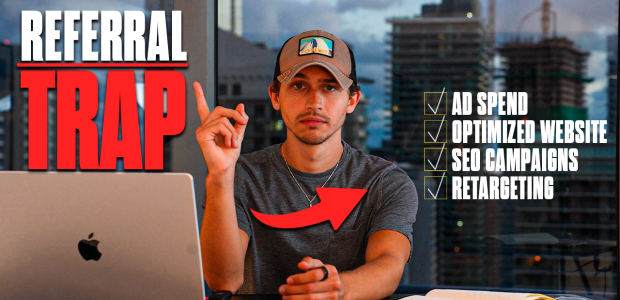
- Diversified acquisition sources are essential: Meta ads, SEO, website optimization, retargeting, and database reactivations
- The digital acquisition web acts as a net to catch leads from multiple sources, ensuring no holes in your pipeline
- Ad spend as fuel: The more you invest wisely, the farther your campaigns go, track ROAS, and cost per acquisition
- Database reactivation campaigns can turn cold leads into hot opportunities through strategic seasonal outreach
- No such thing as slow seasons, businesses with proper systems thrive year-round, regardless of external conditions
- The slow bleed: Businesses relying only on referrals are slowly losing momentum, and many don’t realize it until it’s too late
Table of Contents:
- What the Referral Trap Actually Is
- Why Even Established Companies Are Losing Steam
- First Arm of the Web: Meta Ads (Facebook & Instagram)
- Understanding Ad Spend as Fuel, Not Expense
- The Center of the Web: Your Website
- SEO Campaigns for Long-Term Growth
- How Retargeting Patches Up the Holes
- Stop Blaming Slow Seasons
- Database Reactivation: Reigniting Old Leads
- The Slow Bleed of Referral-Only Businesses
- What Working With Dirt2Dollars Looks Like
My name is Brady Carlson, and I’m the co-founder of Dirt2Dollars. We build marketing and acquisition systems for blue-collar businesses all over the United States.
In this article, we’re going to go over what we call the digital acquisition web.
And we’re going to go over a handful of methods that, yes, will generate more referrals and word-of-mouth customers for you, but will also keep you in front of new buyers consistently.
New buyers who have no idea who you are.
They’ve never been exposed to your business or your brand.
They might not even know who you are.
You have to get in touch with that group of people and convert them into deals.
That’s where success and real growth will be seriously stimulated in your business.
What the Referral Trap Actually Is
Let’s talk about the biggest threat to your contracting business, your service-based business, your land management business, or any service-based businesses in general.
It’s not a recession. It’s definitely not the economy, and it’s not even your competitors.
The biggest threat currently facing your blue-collar business is the referral trap. Only relying on referrals and word of mouth to fuel your business.
If all or even most of your business comes from word of mouth and referrals, it’s not predictable or scalable.
Why Even Established Companies Are Losing Steam
I’ve spoken with hundreds of businesses that have struggled with this issue, and I know there are thousands more out there.
And the problem is that even the more well-established companies that have been around for years are starting to lose steam and momentum at a rate I’ve never seen before.
It comes down to the simple fact that they lack diversified acquisition sources.
All of their work comes from word of mouth and referrals. They’re waiting for the phone to ring, for someone to stumble across their website, for someone to send a referral their way, or for a repeat client to have more work for them.
This is the biggest threat facing your business right now.
The Goal: Predictable Revenue
We’re going to review our favorite acquisition sources and how you should structure a digital web or net around your business. This way, you’ll never worry about or guess when the next job will come in.
We could be in a recession.
We could be in a new golden age.
It doesn’t matter what the case is; you’re never going to have to struggle for work ever because you’ll be diversified in where it comes from.
If you compare the guy who has all the acquisition sources built out for himself and the digital acquisition web structured around his business to the guy who relies solely on word of mouth and referrals, you’ll see a clear difference and noticeable growth in the one who is effectively using acquisition sources.
The ideas and strategies I’m about to share have proven effective for our clients and the businesses that implement them.
We’ve worked with hundreds of businesses, so we’ve thoroughly tested many of these strategies.
Think of It as a Net
Think about the web as a net that’s designed to catch overflow traffic from all of your acquisition sources.
First Arm of the Web: Meta Ads (Facebook & Instagram)
We’ll start with the first one. The initial acquisition source, the first part of this web where many people turn to when they’re moving away from only relying on word of mouth and referrals, is Meta ads. So, Facebook and Instagram.
That’s usually where we end up pushing a lot of people, too.
If nothing else has been established in the business, if there’s no stream and no volume coming from Meta, that’s probably where we’ll start first and connect them to that new group, that colder audience, to generate that volume push beginning.
Common Mistakes to Avoid
A few common mistakes we see when people use Facebook and Instagram is that they boost posts.
Don’t boost posts.
You have no control over where your ad dollars go or where your ads are placed. It’s basically like a shot in the dark.
Stop relying on simple tactics like boosting posts, posting exclusively in the Marketplace, or just sharing content on your Facebook page and calling it digital advertising.
These methods may seem organic, but they will leave you waiting for people to stumble upon your content. To truly reach your audience, you need to implement effective ad campaigns on Facebook and Instagram.
Get Into a Real Ad Account
Now, Facebook owns Instagram, so you can kill two birds with one stone here and target both platforms at the same time.
Where you want to be is in a Meta ad account. This lets you manually create campaigns, design your ads, set up the campaigns there, and then actually show them to the right audience, those who are most likely to be your ideal buyers, rather than just showing your content to anyone and everyone.
It’ll allow you to take full control over your ad dollars and divert them to places that are most potent and able to attract the most leads, and, more importantly, the right type of leads.
Understanding Ad Spend as Fuel, Not Expense
When it comes to ad spend, this applies to virtually any type of paid ad, whether on Facebook, Instagram, Meta, Google, TikTok, or YouTube. You want to analyze ad spend in the same way.
Don’t look at it as an expense. It’s a tool. It’s a leverage tool. It’s an investment.
The Vehicle Analogy
The way you want to see it is like this: your ad spend is the fuel for the vehicle, and your vehicle is the campaigns you’re running. In this case, we’re talking about Facebook and Instagram. The campaigns you set up there are being directed to those two platforms.
Your ad spend is the fuel that determines how far those vehicles can go on a daily, weekly, and monthly basis.
What Ad Spend Determines
It’s going to determine a handful of things:
- How many people you can show the ads to on a daily basis
- How many leads you get, directly tied to your reach
- How many appointments you book
- How many bids you’re able to get out
- Ultimately, how many deals you’re able to close
Because when it’s all said and done, you want to know exactly what your cost per acquisition is. How much are you actually spending on ad spend to acquire one job, one project, whatever it is, and close one deal?
Track Your ROAS
And then, you should examine your ROAS, or return on ad spend. This means taking the total cash collected and comparing it to what you spent.
For example, did you have to spend $1,000 to acquire one job that paid $10K?
If you spent $1,000 to get a $10,000 job, that would be a 10x return on your investment and ad spend.
However, that’s not typical; it’s just a hypothetical example to help you understand where I’m going with this.
It’s important to track all of these metrics from start to finish, including your actual cost per lead, cost per appointment, cost per bid, your close rate, and your cost per acquisition.
We work with clients, and some of them have extremely high cost-per-acquisition rates. For example, they’ll spend $500 and get a $10,000 job in return, or something similar. Others might spend much more; some will spend around $5,000 and receive a $50,000 job back.
Again, these are examples to help you understand what to look for: you want to know, okay, how much did I spend to acquire that job? How much new cash? How much revenue did that job generate for the business? This way, you can calculate your return on ad spend.
The Scaling Formula
Once you understand this, let’s return to our hypothetical example.
If you spend $1,000 to secure a $10,000 job, and you can do this multiple times with consistent results, not just a one-off, and you have more data to support it, then it becomes clear: you spend $1,000, get that job, and receive a certain amount back.
That’s the goal.
That’s the way to approach scaling ad campaigns initially. So, I spent $1,000 to gain one job. The quicker you spend that $1,000, the sooner you’ll get that job back. That’s how you should view and measure it.
But Meta is just one arm of the web.
The Center of the Web: Your Website
Next, let’s explore different areas of the web. We’ll start with Google, which we consider a fundamental part of the web.
A well-optimized SEO website acts as the main destination for people to find you from any ads you run, whether it’s Facebook, Instagram, Google Ads, TikTok ads, or YouTube ads. It doesn’t matter if you’re doing a database reactivation or similar strategies; having a solid website is a non-negotiable.
How the Web Works Together
For example, you’re running Meta ads, and someone sees your ad.
They see your ad on Facebook, but they don’t decide to opt in right there by filling out the form or whatever it is, and they don’t opt in through your sales process.
Instead, they click your page, browse a little, see your website in the about section, and then visit it.
If your website is optimized to capture and convert leads that didn’t convert on your paid ad campaigns, you catch those leads on your website instead of missing them on the Meta ad website.
You can start to see and visualize how the web will be built here. It’s stability. It’s stability in every section of it, and using one campaign to benefit another, and then having your organic, your website, the anchor, kind of everything set in the middle.
No Holes in the Net
So, it’s like there are no holes in the net. People can bounce around as much as they want. They go from Facebook to TikTok, and they can be retargeted on TikTok; they can see your ad there.
But as I mentioned, it’s important to have a solid foundation in the middle, which, in most cases, is just a well-optimized website.
SEO Campaigns for Long-Term Growth
After setting up your ads and website, the next step is to run SEO campaigns on Google. Having a well-optimized website and running campaigns targeting specific keywords helps your site rank higher on Google, which means that when someone searches for a “land clearing contractor near me,” “roofer,” or “roofer near me,” your business appears at the top of the list.
That’s the ultimate goal of SEO.
It Takes Time, But It’s Worth It
An SEO campaign operates as its own branch of the web, impacting everything and working effectively.
However, it requires a significant amount of time. Optimization is a lengthy process. Typically, even for our own business, it took around 6 or 7 months of consistent effort with SEO campaigns and boosting our Google presence before we started noticing tangible results.
Although it has a longer turnaround period, it’s a very good long-term investment.
And I’d recommend starting it as soon as you possibly can, so that way down the road, you’ll start to see the organic leads, the free leads, if you will, coming in and finding you that way just because you have very good SEO and your Google presence is tip-top, and it’s dialed in.
How Retargeting Patches Up the Holes
I don’t want to lose anyone here, but if you’re still following me, what’s also great is that you can retarget website visitors through Meta. If someone finds you on Google, the first time they interact with your business or see something about you is on Google.
They click on your website, but they don’t opt in or leave, whatever the case may be.
You can set up Meta campaigns to retarget those website visitors. So, when they later open Instagram, Facebook, or any other paid platform like YouTube or TikTok, they will see your ads, increasing the chances they’ll opt in.
Every Source Complements Each Other
Again, that’s how the network is patched up in all areas. Every potential acquisition source complements itself. When done correctly, you’ll have a very strong system.
Stop Blaming Slow Seasons
I want to emphasize this. People tell us about slow seasons and say, ‘Oh, it’s just the way it is at this time of year.’ But there’s no reason to think like that.
You can close deals at any time of the year. It doesn’t matter when it is. You can still entertain buyers in the middle of winter or when you’re busy in the summer. It really doesn’t matter.
Stop Making Excuses
Many contractors claim that the slow season and the current state of the economy are preventing them from scaling their businesses. I know I might get some flak for saying this, but I believe there are other factors at play.
It’s normally not the reason that you can’t scale your business.
We have seen businesses thrive even under the worst imaginable external macro conditions.
And it’s because they have the systems built out and the acquisition sources diversified in their business.
They don’t have to guess.
They don’t have to wonder when their phone will ring again.
They don’t have to wonder when somebody’s going to stumble across their website and just happen to opt in.
They don’t have to wait for a client that they worked for two years ago to refer their neighbor. It’s not unpredictable at all.
Database Reactivation: Reigniting Old Leads
Another important point is that once you’ve built a large pool of leads, including names, phone numbers, and emails from various sources, you can launch large-scale database reactivation campaigns.
So, anyone who never closed with you, meaning they didn’t finalize a deal, you couldn’t convert them, you didn’t secure their project for any reason, or maybe it just wasn’t the right time for them, when you get that list of names, phone numbers, and emails, you can target them again with emails.
How to Run a Reactivation Campaign
You can run a large campaign by blasting emails, texts, or other channels to engage your audience.
You might have a seasonal offer for your business, or, with Black Friday approaching, you can promote a Black Friday deal or special to your entire growing database of contacts, names, phone numbers, and emails that have interacted with your business to reignite old sales conversations.
Get people to start talking about getting their project done again, getting their job completed.
When to Run Reactivations
When everything is done correctly, that’s when you can leverage the data collected from organic or paid traffic on the back end. So, database reactivations will be significant, and you can manage them effectively seasonally.
As I mentioned, Black Friday, Christmas, and New Year’s are coming up. You could do July 4th, Labor Day, and Memorial Day. There are so many different occasions that you could run a database reactivation around.
Or, the beautiful thing is you can do one randomly out of the blue, like in the middle of April or something.
It doesn’t matter when you actually do it.
The goal is to get the messaging across to hundreds, if not thousands or tens of thousands, of leads and people you weren’t able to close or convert for one reason or another, and just reignite that sales conversation with them.
Reigniting that conversation about them wanting to get their project done. Keeping your business at the front of their mind consistently.
Good Back-End Systems Matter
When you have good back-end marketing systems built out, you can seriously improve your CRM management through strategic database reactivation campaigns.
Then you can re-engage with leads that have gone cold or seemed unpromising at first; these leads can be transformed into highly interested prospects. With the right approach, you will turn those neglected leads into valuable opportunities.
The Slow Bleed of Referral-Only Businesses
I hope all of this makes sense to the people who haven’t thought about it like this before. I hope the analogy makes sense. But it’s really, really important to do. And this is how you’re actually going to futureproof your business.
Comparing the Strategies We Covered:
Feature | Referral Marketing | SEO (Organic Acquisition) | Paid Acquisition (Meta, Google, TikTok, YouTube) |
Speed to Results | Slow & unpredictable, depends entirely on when someone happens to refer you | Slow (months), requires ongoing optimization before rankings climb | Fast, immediate volume once campaigns launch |
Cost | Very low (but costly in lost opportunities) | Low per acquisition long-term; time-intensive upfront | High per acquisition; scalable with ad spend |
Trust / Credibility | Highest, personal recommendations | High, earned authority through strong Google presence | Lower, seen as advertising unless paired with strong content/website |
Lead Quality | Very high, pre-vetted by a friend/client | High, prospects actively searching for solutions | Variable, depends entirely on targeting & campaign structure |
Scalability | Extremely limited, cannot scale referrals on demand | Moderate, scales as rankings improve and content grows | Very high, scale instantly with more budget & optimized campaigns |
Predictability | Very low, feast-or-famine cycles | Moderate, grows consistently once authority is built | High, predictable flow when tracking CPL, CPA, and ROAS |
Control | None, you can’t control when referrals show up | Medium, you control optimization but not Google timelines | Full control, targeting, budget, messaging, frequency |
Role in the “Acquisition Web” | Supplemental, should never be the main source | The anchor, captures spillover from all paid channels | The volume driver, cold traffic, retargeting, and scalable demand |
Ideal Use Case | Enhancing credibility & closing warm leads | Long-term stability, brand authority, free inbound traffic | Rapid growth, consistent appointments, predictable revenue |
It’s Happening Right Now
As I said, many of the businesses, newer and older, that we see and talk to that rely on word of mouth and referrals are implementing a slow-bleed process.
It’s a slow bleed.
And it’s tough to see, because we’ve had people who have opted in with us before and inquired with us, but they didn’t make that change.
If they weren’t comfortable making that change, even adding one of those acquisition sources to their business to start diversifying where the work’s coming from can make a big difference.
Maybe we run our own database reactivation campaign, maybe they reach out of the blue, or we reach out of the blue to just check in, whatever it is, and they’ve digressed.
Or, what’s obviously the worst, is when you’ve spoken to somebody and they are a little uncomfortable making a decision or a change.
And now, all of a sudden, they’re digressing, their business is shrinking, and you can see that slow bleed happening.
Or you know, nothing’s changed at all.
You Have to Make the Change
If you’re comfortable with nothing changing at all and wanting things just to be stagnant, because that’s a conversation that you’ve got to have with yourself. But you’ve got to be willing to make the change, because implementing many of these things won’t be very comfortable.
It might be new, might seem a little scary to you. There are a lot of things that could come up in your mind. Oh, like what if it doesn’t work? Too many people have already proven it works for you, not to try it.
So we would say the risk-to-reward is pretty favorable.
But the businesses we are seeing implement and build out a website correctly are thriving. They’re not worried about where the next job or project is coming from.
What Working With Dirt2Dollars Looks Like
This entire system we walked through, building Meta ads, some form of social media paid campaigns, a way to convert leads on the back end, and the right sales process, is going to be huge when it comes to scaling your business and pushing it to new highs every month and quarter.
This Is Just the Foundation
We barely scratched the surface of any of these topics we covered today. But I wanted to make sure you have at least the main points and key takeaways, including the basics of building a digital acquisition website, where to focus, and how to diversify your lead sources.
All of these things are super important, and if you don’t implement them, you can be sure that, at some point, your competition will.
What You Get
You get a full-scale marketing team. We specialize in everything from Meta ads to Google ads, TikTok ads, cold email, organic, you name it. We’re skilled in all aspects of digital marketing.
You have an in-house sales team. We’re actually calling every single one of your opportunities on your behalf.
You get full access to our entire team. You get full access to me, my business partner, and a unified communications channel, making everything seamless.
We’re really focused on communication so that your team has full access and complete 24/7 transparency with our team and vice versa. And we obviously love helping land management companies scale.
Ready to build your digital acquisition web? Book a call with our team to see if we’re a good fit to help you escape the referral trap and scale consistently.