How Contractors Close MORE Deals Using the 10/10/10 Rule and On-Site Deposits

I hope you enjoy reading this blog post.
Author: Brady Carlson | Co-Founder of Dirt2Dollars
Published Date: 9 April, 2026
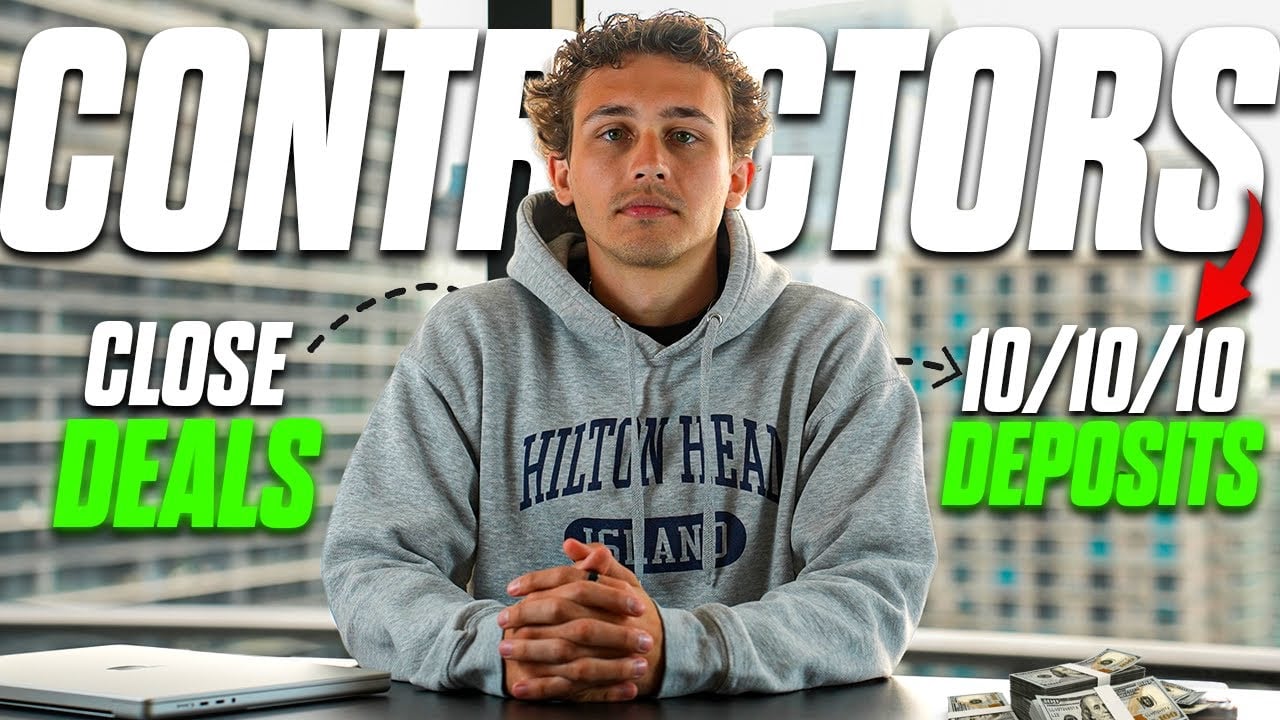
Let me ask you something: how many times do you follow up with a lead before you give up?
If your answer is “I call once or twice and move on,” you’re leaving tens of thousands of dollars on the table every single month. Maybe more.
At Dirt2Dollars, we generate leads for contractors across the country – land clearing, excavation, forestry mulching, outdoor living, you name it. And after watching hundreds of contractors work those leads, I can tell you exactly where the money gets left behind. It happens in two places: follow-up and closing.
Today I’m going to give you two strategies that will immediately change your close rate. These aren’t theories. These are battle-tested systems that our most successful clients use every single day.
Watch the full breakdown:
The 10/10/10 Rule: Why Most Contractors Give Up Way Too Early
Here’s the rule, and it’s non-negotiable if you want to maximize your pipeline:
Every single lead gets 10 calls, 10 emails, and 10 texts before you write them off.
That’s 30 total touchpoints. Not 3. Not 5. Thirty.
I can already hear you: “Brady, that’s insane. If someone doesn’t pick up after two calls, they’re not interested.”
Wrong. Dead wrong.
Here’s what you need to understand about paid leads versus referrals. When your buddy sends you a referral, that homeowner is already at a 10 out of 10 on the buying scale. They’ve been told you’re the guy, they trust the recommendation, and they’re ready to go. All you have to do is show up and not screw it up.
Paid leads are different. A paid lead might be at a 5 out of 10. They know they need land cleared or a lot graded, but they’re still early in the process. They’re researching. They’re comparing. They’re not sure about timeline or budget yet.
That doesn’t make them bad leads. It makes them leads at a different buying stage. And your job – YOUR job as the business owner – is to warm them from a 5 to a 10.
You do that through consistent, persistent follow-up.
Speed to Lead: The First 5 Minutes Are Everything
Before we even get to the 10/10/10 cadence, let’s talk about speed to lead.
When a new lead comes in – whether it’s from a Facebook ad, a Google search, or your website – you need to call them within 5 minutes. Not an hour. Not “when you get off the jobsite.” Five minutes.
Why? Because that homeowner just filled out a form. They’re sitting on their phone, thinking about their project, and they’re engaged RIGHT NOW. If you wait three hours to call, they’ve moved on. They’ve filled out two more forms. They’ve forgotten about you.
The contractor who calls first wins the appointment. That’s not an opinion – that’s data we’ve seen across hundreds of campaigns.
Set up notifications on your phone. Have someone in your office dedicated to speed-to-lead calls. Whatever you have to do, be the first voice they hear after they express interest.
How the 10/10/10 Cadence Actually Works
Here’s what consistent follow-up looks like in practice:
Double dial – AM and PM. Call in the morning, call again in the afternoon or evening. People are busy. They might miss your call at 9 AM but pick up at 6 PM. Two calls per day is not aggressive – it’s thorough.
Mix your channels.** Don’t just call. Text them. Email them. Some people hate phone calls but will respond to a text in 30 seconds. Some people ignore texts but read every email. **You don’t know their preference until you try all three.
Space it out but stay consistent. You’re not hitting them with all 30 touchpoints in two days. Spread it over 2-3 weeks. Stay persistent without being obnoxious.
Leave voicemails that create curiosity. Don’t leave a 90-second voicemail about your company history. Say something like: “Hey, this is [Name] from [Company]. I’m calling about the land clearing project you inquired about. I’ve got some availability in the next couple weeks and wanted to see if we could get you on the schedule. Give me a call back at [number].” Short, specific, action-oriented.
Here’s the thing most contractors don’t realize: many of your best deals will come from leads who didn’t answer the first five times. I’ve seen it happen over and over. A lead goes dark for a week, the contractor keeps following up, and then on call number eight the homeowner picks up and says, “Yeah, I’ve been meaning to call you back. When can you come out?”
That’s a $15,000 job you would have lost if you gave up after two calls.
On-Site Deposits: Stop Letting Verbal Yeses Steal Your Time
Now let’s talk about the second strategy, and this one might be even more important.
A verbal yes means absolutely nothing.
I don’t care if the homeowner looked you in the eye, shook your hand, and said “You’re the guy – let’s do this.” Until there’s money on the table, you don’t have a deal. You have a nice conversation.
Here’s what happens without deposits: You drive 45 minutes to a property. You spend an hour walking the lot, measuring, assessing the work. You drive 45 minutes home. You spend another hour putting together a detailed bid. You email it over. And then… crickets.
No response to your email. No callback. They got three other bids and went with the cheapest one. Or they decided to wait until next year. Or they just ghosted you entirely.
The ghost rate on emailed bids is over 50%. More than half the bids you email will never get a response. Think about how much time and fuel you’re burning on estimates that go nowhere.
The fix is simple: collect a deposit before you leave the property.
How On-Site Deposits Work
When you’re on-site doing an estimate, you walk the property, assess the work, and give them a price – in person, on the spot. Not later. Not via email. Right there.
Then, before you leave, you collect a deposit. $200 to $1,000 depending on the size of the job. For a $5,000 land clearing job, a $200-$500 deposit is reasonable. For a $50,000 excavation project, $1,000 is nothing.
Here’s why this works on multiple levels:
It separates serious buyers from tire-kickers. Someone who puts down $500 is committed. They’re not shopping around anymore. They’ve made a decision, and money has changed hands. That’s a psychological commitment that a handshake can never replicate.
It prevents flaking. Once someone has money invested, they don’t ghost you. They show up for the project. They return your calls. They’re engaged because they have skin in the game.
It covers your time even if they back out. Let’s say someone puts down $500 and then changes their mind. You keep the deposit for your time and fuel. You were going to eat that cost anyway – now at least you’re compensated for the estimate.
It eliminates the email bid problem entirely. You’re not sending a bid into the void and hoping for a response. You’re delivering the price face-to-face, handling objections on the spot, and closing the deal before you walk off the property.
Stop Emailing Bids - Deliver Them in Person
This deserves its own section because it’s that important.
Do not email bids.** I’ll say it again: **do not email bids.
When you email a bid, you lose all control of the narrative. The homeowner opens your email, sees a number, and immediately starts comparing it to whoever else they got a quote from. They have no context. There’s no conversation. There’s no opportunity to explain your value, address concerns, or overcome objections.
When you deliver the bid in person, you control the entire experience:
- You walk them through the scope of work
- You explain WHY you’re priced the way you are
- You highlight what’s included that competitors leave out
- You answer questions in real-time
- You handle objections on the spot
- You ask for the deposit before you leave
The close rate difference between emailed bids and in-person bids is staggering. We’re talking about the difference between closing 20% and closing 50%+.
Control the narrative from start to finish. From the moment a lead comes in, to the follow-up cadence, to the on-site visit, to the bid delivery, to the deposit collection – you should be in the driver’s seat at every stage.
Putting It All Together: The Full Sales System
Let me paint the picture of what this looks like when you combine both strategies:
- Lead comes in → You call within 5 minutes
- No answer? → Begin the 10/10/10 cadence. Double dial AM/PM, text, email.
- They pick up → Book the on-site appointment immediately
- On-site visit → Walk the property, assess, build rapport
- Deliver the bid in person → Right there on the property, face to face
- Handle objections → Answer every question, address every concern
- Collect the deposit → $200-$1,000 before you leave the property
- Deal closed → Move to scheduling and execution
That’s a system. That’s repeatable. That’s scalable. And that’s how you go from closing 2 out of 10 estimates to closing 5 or 6 out of 10.
At an average ticket of $10,000-$15,000, closing an extra 3 deals per month is an additional $30,000-$45,000 in revenue. Per month. Just from improving your follow-up and closing process.
The Mindset Shift You Need to Make
Both of these strategies require the same mindset shift: stop being passive in your sales process.
Most contractors wait. They wait for leads to call back. They wait for emailed bids to get responses. They wait for someone to say yes. And while they’re waiting, the aggressive contractor down the road is calling, texting, showing up, and closing.
Be the aggressive contractor. Not aggressive in a pushy, sleazy way – aggressive in a “I’m going to be thorough, persistent, and professional at every step” way.
Your leads aren’t low quality. Your follow-up is low effort. Fix that, and the revenue follows.
Ready to Build Your Own Growth Machine?
If you’re a contractor in the United States and you’re tired of relying on word-of-mouth or competing on lead-sharing platforms like Angie’s List, we should talk.
We’ve generated over $42+ million in land clearing estimates for contractors across the country – and we’re just getting started.
Book a Call with Our Team https://link.toolboxx.co/widget/bookings/intro-blogs